THE REAL DANGER OF ARTIFICIAL INTELLIGENCE
Ever since I was very young, I remember drawing cartoons and caricatures of my cousins at family gatherings as part of the day’s entertainment.
Throughout high school, I spent more than five years struggling to keep my grades at least somewhere around average because I simply could not stop playing guitar or my five-octave Casio keyboard, which today would probably qualify as a museum piece.
I wasn’t the best student. And yet, years after graduating, I was told that for some time my English thesis had been used as an example of what a well-written thesis should look like.
The subject?
An in-depth analysis of the music of Sepultura, the Brazilian thrash and death metal band. Many of their lyrics brutally reflected the inequality and social realities of their environment: favelas, violence, and conflict.
Interestingly enough, during that same final year of high school, my team and I also won the school music competition using music by that very band, along with original material composed by me and an old buddy.
We beat the students who were considered the best musicians in our graduating class. Our own songs and Sepultura went up against some seriously fierce competition playing Richard Clayderman and Silvio Rodríguez with knives between their teeth.
Years later, I owned a company specializing in website development and digital communications for eleven years. It was a dark period of my life in many ways, but also one of tremendous learning.
After closing that company, I completed approximately 90% of a Master’s program in Game Design at Full Sail University, an institution recognized for its programs in video games and digital media.
For more than a year, professors with real industry experience evaluated my work. My primary focus eventually gravitated toward one of the fields that interested me most: music and audio for video games.
My academic average was 4.6 out of 5.
For three decades, these “hobbies” remained a permanent part of my life while my professional career in advertising seemed unable to truly take off.
For anyone who knows me, connecting all of these subjects to who I am is fairly easy.
One could therefore argue that the foundations required for the work I now want to pursue professionally did not suddenly appear five years ago.
They had been evident since I was very young.
THE AI BOOM TODAY — AND THE DANGER
And yet, whether they know my history and the road that brought me to these shores or not, some people close to me—and some complete strangers—have somehow arrived at the conclusion that ChatGPT is doing the writing, composing, producing, designing, and creating for me.
Cynical.
This, in my view, is one of the real dangers of artificial intelligence: how easy it has become to conclude that behind something created with genuine passion, imagination, and human skill, there is nothing more than a prompt and a machine.
At what point does reasonable scrutiny turn into an unjustifiable accusation?
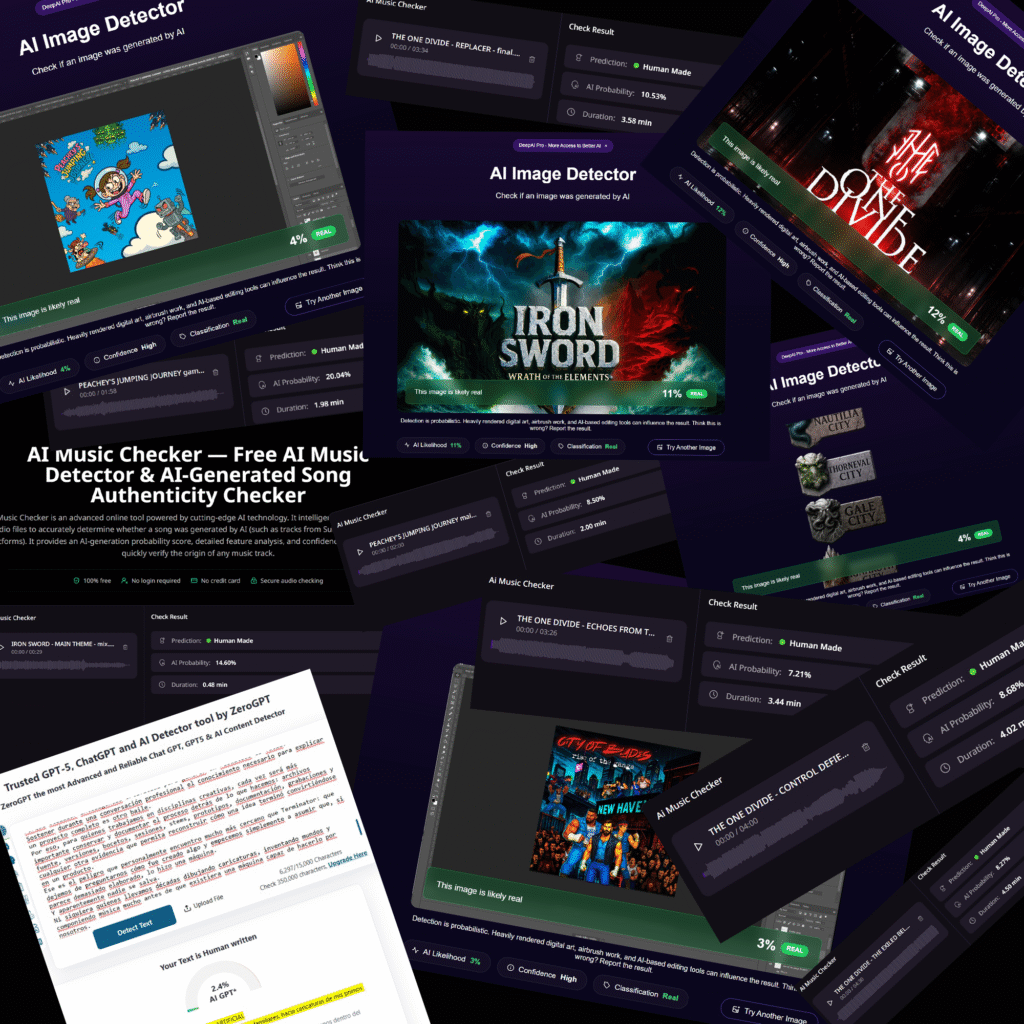
More than ever, developers and creators need to maintain a verifiable record of their creative process.
Adding an illustrated tiger to a photograph is something people have been doing relatively easily since the last century with Photoshop or practically any image editor.

AI-generated photo

AI-generated photo + Photoshop + Blender + Clip Studio
But going from that to building five intellectual properties with documentation covering gameplay systems, combat, lore, and narrative; creating an entire digital ecosystem, websites included; and producing music with deliberate choices in chord progressions, melodies, arrangements, mixing, and concept requires a process behind it.
And that process is precisely what should be examined before anyone starts offering opinions.
Stripping someone of authorship through an ignorant and uninformed opinion—without even knowing how to play the maracas or understanding how video game development works—can become disturbingly cruel.
And this is exactly what creative developers are going to face.
Their work will increasingly be subjected to scrutiny and, in many cases, they will have to be capable of proving their authorship.
BRUTAL BARRIERS TO ENTRY
At least in creative production, there are already security guards at the gate—and they are armed to the teeth.
A portfolio may open the door. But then come the interviews, the tests, the technical questions, and the examination of your process.
For God’s sake.
Only a fool would try to land a professional job in music production—or sell those services—by deliberately filling a portfolio with Suno songs and Midjourney artwork and then expecting to survive a professional evaluation.
And this is where the argument becomes even more absurd.
If there are genuine doubts about where someone’s work came from, there are perfectly reasonable ways to clear them up.
Here is the most effective one:
Ask.
Ask the supposed author to explain what they did. Ask why they made a particular decision. Ask them to change something and open the session.
Ask them to play the instrument. Ask them to explain the plugin and VST chain in the mix.
Ask them to justify a gameplay mechanic. Ask them to explain the pipeline through which they took a piece of concept art and turned it into an interactive 3D model inside Unreal Engine 5.
That is usually where the mystery ends very quickly.
Because using artificial intelligence to generate a result is easy.
Being able to sustain a professional conversation and demonstrate the knowledge required to explain an entire project is a very different dance.
That is why, for those of us working in creative disciplines, preserving and documenting the process behind our work will become increasingly important: source files, versions, sketches, sessions, stems, prototypes, documentation, recordings, and any other evidence capable of reconstructing how an idea eventually became a finished product.
That is the danger I personally find far more immediate than Terminator: that we stop asking how something was created and simply begin assuming that, if it looks too elaborate, a machine must have made it.
And apparently, nobody is safe from that.
Not even those of us who have spent decades drawing caricatures, inventing worlds, and composing music long before there was a machine capable of doing any of it for us.